
There is a lot of misinformation online about Cat6 Ethernet cables. Do they carry signals further than Cat5e? Do they improve your internet speed? In this guide, we will separate fact from fiction and help you decide if Cat6 is the right choice for your network.
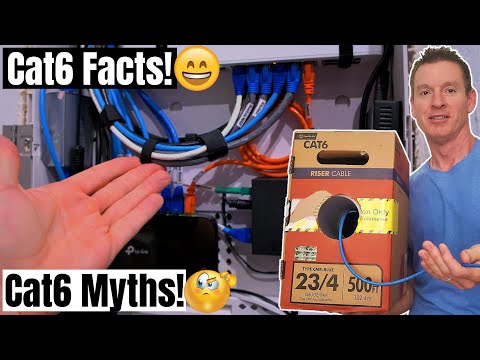
| Myth | Fact |
|---|---|
| Cat6 cables carry signals further than Cat5e. | False. Both Cat5e and Cat6 have a maximum run length of 328 feet. |
| Cat6 improves internet speed. | False. Your ISP determines your internet speed. Cat6 improves internal network speed, not your internet connection. |
| Cat6 is harder to install than Cat5e. | False. Both cables install similarly, although Cat6 has slightly thicker sheathing. |
| Cat6 is always the best choice. | False. If your network does not exceed 1Gbps, Cat5e is still a viable option. |
Cat6 is a great choice if you plan to future-proof your home or transfer large amounts of data within your network. However, if your internet speeds are 1Gbps or lower, Cat5e will work just fine.
Welcome back! Today, we are discussing Cat6 Ethernet cables and separating fact from fiction.
One common misconception is that Cat6 carries signals further than Cat5e. This is false—both have a maximum run of 328 feet. However, Cat6 has higher bandwidth (250 MHz vs. 100 MHz for Cat5e), allowing it to process more data at once.
Another myth is that Cat6 improves your internet speed. This is only true if you are transferring files between devices within your network. If your ISP provides speeds of 1Gbps or less, Cat6 will not make your internet any faster.
Durability is another factor. Cat6 is generally more robust due to its thicker sheathing and, in some cases, a nylon spine that enhances stability.
Is Cat6 harder to install than Cat5e? Not really. The installation process is similar, and in most cases, they look and feel the same.
Many people assume Cat6 is always the best option. While it is an excellent choice for future-proofing, Cat5e is still sufficient for most networks, especially if your speeds do not exceed 1Gbps.
If you are building a new house, running Cat6 is recommended. However, Cat5e is still a viable and cost-effective option.
For those interested in learning how to wire-drop Cat6 cables, check out our related video and home networking playlist!

This video is all about Home Networking Basics. These are the fundamentals of any Home Network from modem to router to ...

This is the complete TP-Link Omada setup guide for Home Networks or small businesses. TP-Link sent us these 4 products for ...

If you want to install Cat6a in your Home Network, then you need to learn these 2 installations first! Cat6a Cable Termination ...

How to wire up Cat6a UTP the easiest and best way! This is a detailed "How-To" video on Cat6a Unshielded Twisted Pair ...

This Video is Sponsored By www.elvishredlight.com High-Quality Red Light Therapy Panels at the Lowest Prices!

Do you want Faster Wi-Fi Speeds? This video shows you 1 simple setting to get faster Wi-Fi speeds! This works for all Wireless ...